
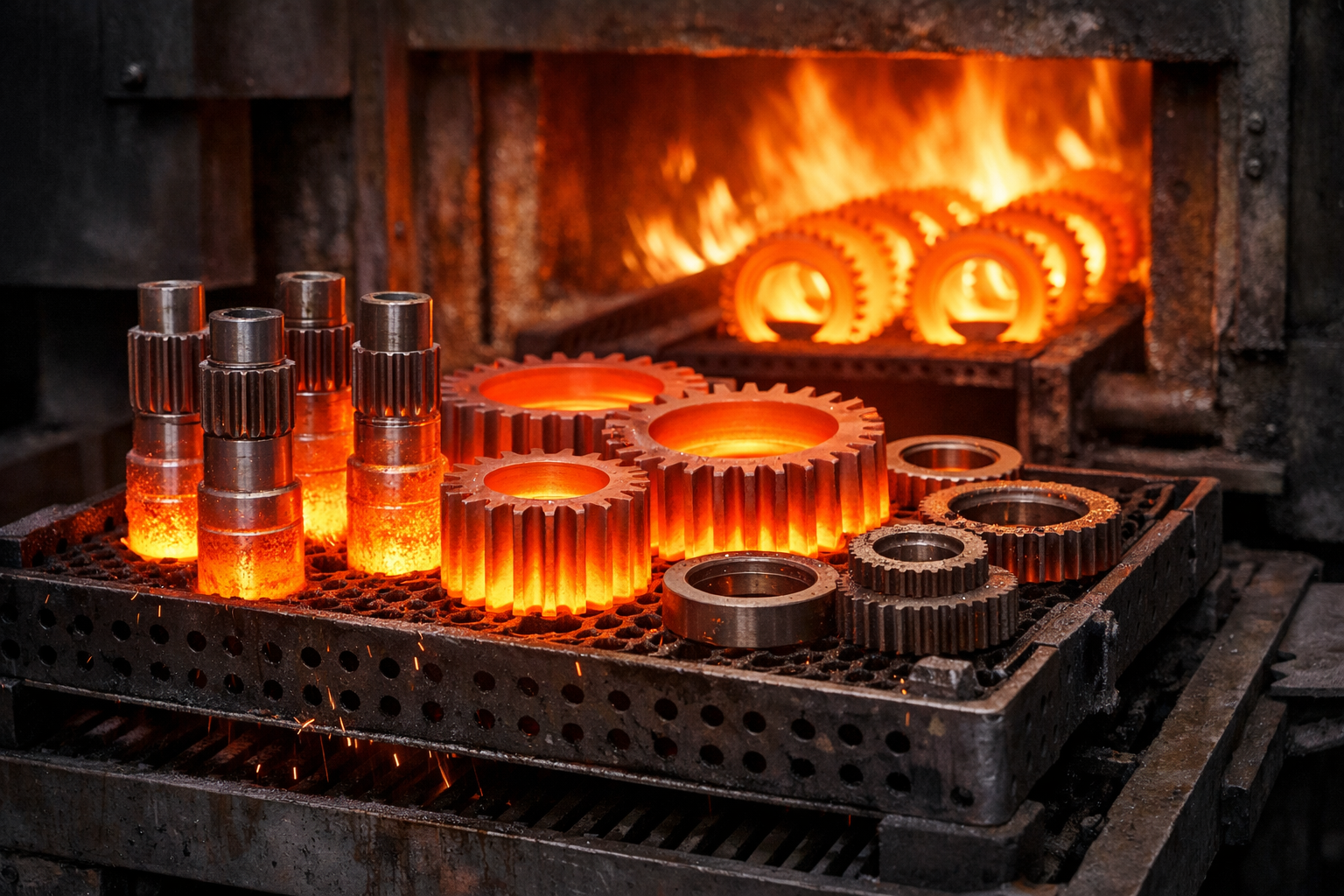
Material properties can be transformed through heat treatment. A steel component that is soft and easy to machine can be hardened to provide wear resistance and strength where it is needed. At Atlas MBD, heat treatment is not an external service we contract out. It happens in-house, integrated with our machining workflow, ensuring quality control and efficiency.
Heat Treatment Processes
We provide a range of heat treatment processes tailored to your material requirements:
Hardening
Steel is heated to austenitic temperature and then rapidly cooled to create a hard, brittle structure. Hardening is essential for tools, wear surfaces, and components requiring high strength and wear resistance.
Tempering
After hardening, parts are reheated to a lower temperature to reduce brittleness and improve toughness. Tempering is controlled to achieve the desired balance of hardness and mechanical properties for your application.
Annealing
Parts are heated and slowly cooled to relieve internal stresses and soften the material. Annealing is used before machining difficult materials or to restore ductility after cold working.
Normalising
Steel is heated above critical temperature and air cooled to refine the grain structure and improve mechanical properties. Normalising enhances strength and uniformity, particularly useful before precision machining.
The Advantage of In-House Heat Treatment
By carrying out heat treatment in-house, we achieve advantages that external suppliers cannot match:
Coordinated Workflow
Parts progress from rough machining to heat treatment to finish machining without leaving the facility. Lead times are compressed and logistics overhead is eliminated.
Consistent Quality
One team controls the entire process. No risk of miscommunication about material properties or specification requirements between suppliers.
Process Optimisation
We can recommend heat treatment strategies that optimise machining efficiency. Some materials can be treated at particular stages to make subsequent machining easier or faster.
Cost Efficiency
Integrated manufacturing reduces overall cost. You pay one supplier, not multiple, and benefit from efficient internal logistics.
Materials
We heat treat:
- Carbon steel (structural and tool grades)
- Alloy steel (42CrMo4, 34CrMo4, and other grades)
- Stainless steel (heat-treatable grades)
- Tool steel and specialised high-hardness grades
Specifying Heat Treatment
To ensure we heat treat your components correctly, please specify:
- Material grade and composition
- Required hardness (HV, HRC) or mechanical properties
- Which surfaces or sections require treatment
- Any special requirements or restrictions (distortion limits, surface condition, etc.)
If you are uncertain about heat treatment specification, we are happy to recommend suitable processes based on your application and material.